.svg)



How financial advisors use estate planning to grow AUM
.svg)
.svg)

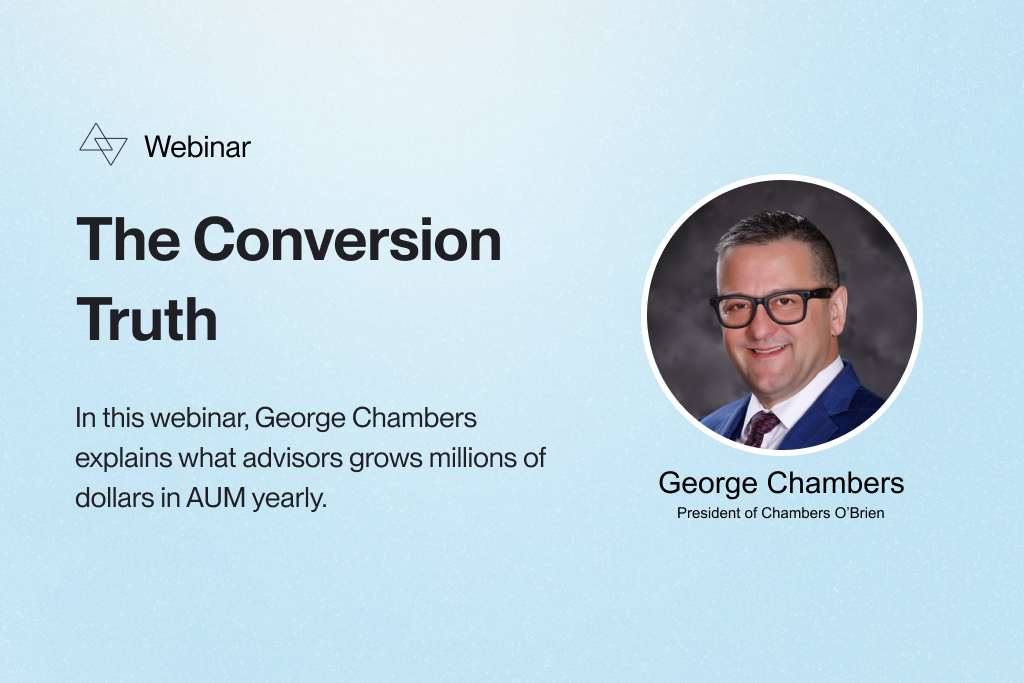

How one advisor uses estate planning to get clients, grow AUM, and build something that lasts
In 1999, George Chambers lost his father, his brother-in-law, and his father’s work team in a plane crash. He lost his father, and his sister lost her husband, still with three children at home, all at the same time.
George’s father had an estate plan drafted. But it was written on paper and was no longer valid once the attorney who drafted it 10 years earlier passed away. Without a plan, everything his father owned went through probate. The new wife received everything. There wasn’t any other evidence to prove a different story.
There was an insurance policy that was still in George’s mother’s name. George helped his family through this time. He took care of his mother, her health, finances, everything. He never forgot what it felt like to experience loss twice. Once when the loved one passes, and again when an estate plan, will, trust, healthcare directives, and financial power of attorney documents are properly completed.
These experiences resonated with Mr. Chambers throughout his career.
“The sincerity of what I do and why I do it is tied to who I am as a person.” Seeing what happens when an estate plan isn’t in place, and intestacy laws take over, changed how George Chambers saw the world. He saw what happened to his family, who were already experiencing several losses.
Mr. Chambers, at the root, does this work not because it converts, but he has seen what happens when it is not done. He did not build a practice that adds $10 to $15 million in AUM and annuity premiums annually. He built it to help families avoid what his family had experienced.
He reminds all that “Legacy planning for a family is the purest form of love. That is why I do this.”
His clients feel the difference. George has made it his mission to provide estate planning for all families. He has built a practice in Florida that puts estate planning at the center of every client relationship. Over 20 years, he added taxes, annuities, life insurance, Medicare, long-term care, and assets under management. The estate planning conversation is how clients come in. Everything else follows.
COVID was influential in putting this into perspective for George and his clients again.
His brother-in-law’s father fell inside a store, hit his head, and was taken to the ER. His brother-in-law drove to the hospital and knocked on the door. The staff turned him away. No power of attorney on file meant that this brother-in-law could not enter to care for his father.
Unlike the missing paper estate plan his dad had, George knew he could use technology to quickly and efficiently help his brother-in-law. As he puts it, “Well, I went to the Estate Guru platform, pressed the button, and it emailed it to my brother-in-law and to the hospital within 15 minutes, and he was in the room helping his dad.”
No hypotheticals. George sees the real outcomes of planning well. He joined our team for a live webinar to share his real experiences and the formula behind his practice.
How do financial advisors use estate planning to get new clients
Financial advisors using estate planning position themselves as wealth managers, rather than just investment managers. When they lead with estate planning for their services, estate planning builds trust across generations and opens referral relationships with attorneys and CPAs.
Knowing the benefit, it’s worth putting time into strategies.
George Chambers runs educational workshops at local colleges. He sees them as low stakes, with no pitch or pressure. He talks honestly about the value of trusts, wills, power of attorney, and what probate will cost families if they aren’t prepared. He finds that about 80% of these workshop attendees then schedule an appointment with him. Then, about half complete a trust.
Those who complete a trust, they start recommending it to their children. The multigenerational retention is built into these conversations.
Another strategy George uses is when an estate is complete, he brings in the client’s children. Sharing the work he has done for their parents is a pull for them. Again, the multigenerational retention model continues into the next generation.
How does estate planning lead to AUM growth for financial advisors
Estate planning leads to AUM because it serves as a way to see the hidden assets and build client loyalty. Helping clients build estate plans moves from planning a portfolio management to a more comprehensive wealth plan.
George sees this with the asset list. He asks every client for their statements. This starts with their bank accounts, annuities, IRAs, 401(k), and life insurance policies. These accounts create the most clear financial picture the client has ever put together in one place. With this clear picture, George can create more detailed and strategic plans to get the client where they want to be and should be.
“It’s not about selling products. It is about the client first, always, and then providing solutions as you get closer to the finish line.”
Not only is this process helpful for creating more comprehensive plans, but it also places George as the person who understands the full wealth picture, beyond the wealth portfolio. Clients who trust advisors with their estate plan do not leave easily. And with most plans leaving wealth to their children, the client’s children are often involved in this process. Advisors then continue leading with relationships for generations.
How do advisors lead the estate planning conversation without overstepping
Advisors can lead the estate planning conversation without overstepping the legal territory. They do so by focusing on legacy, families, and client goals rather than the legal documents. They think about estate planning proactively by offering solutions before a crisis could happen.
Mr. Chambers is very proactive about his own process. He is clear about what his clients need to bring to him and how they can accomplish their financial goals.
“You have to maintain that leadership role. You are not asking clients for their advice. You are giving them what they need to do next.”
He continues to say that if a client starts questioning an answer to an important question, the meeting stops, and they regroup until there is certainty.
The advisor-client relationship continues because he keeps them from offering half-baked solutions. He knows that if there's an incorrect account number or birth date, it won’t protect the right people.
Another important measure he takes is the disclosure he uses with clients. George has worked with our Chief Legal Officer and licensed attorney, CJ. Using our product has given him access to legal partnerships to ask questions and learn what he can and cannot do as a financial advisor. CJ encouraged George to disclose to his clients that he is not an attorney and uses it in every client communication.
What’s inside the webinar
Watch the full conversation to hear what questions other advisors asked and how George continues using our platform to grow his practice.
Our platform is attorney-led, which means we bring the attorney to you. Keep in mind: We are not a law firm and do not provide legal advice–that’s what our in-network attorneys are for. While we work to make sure our information services are accurate, they’re meant as resources. Our materials and services don’t substitute for the advice of an attorney.